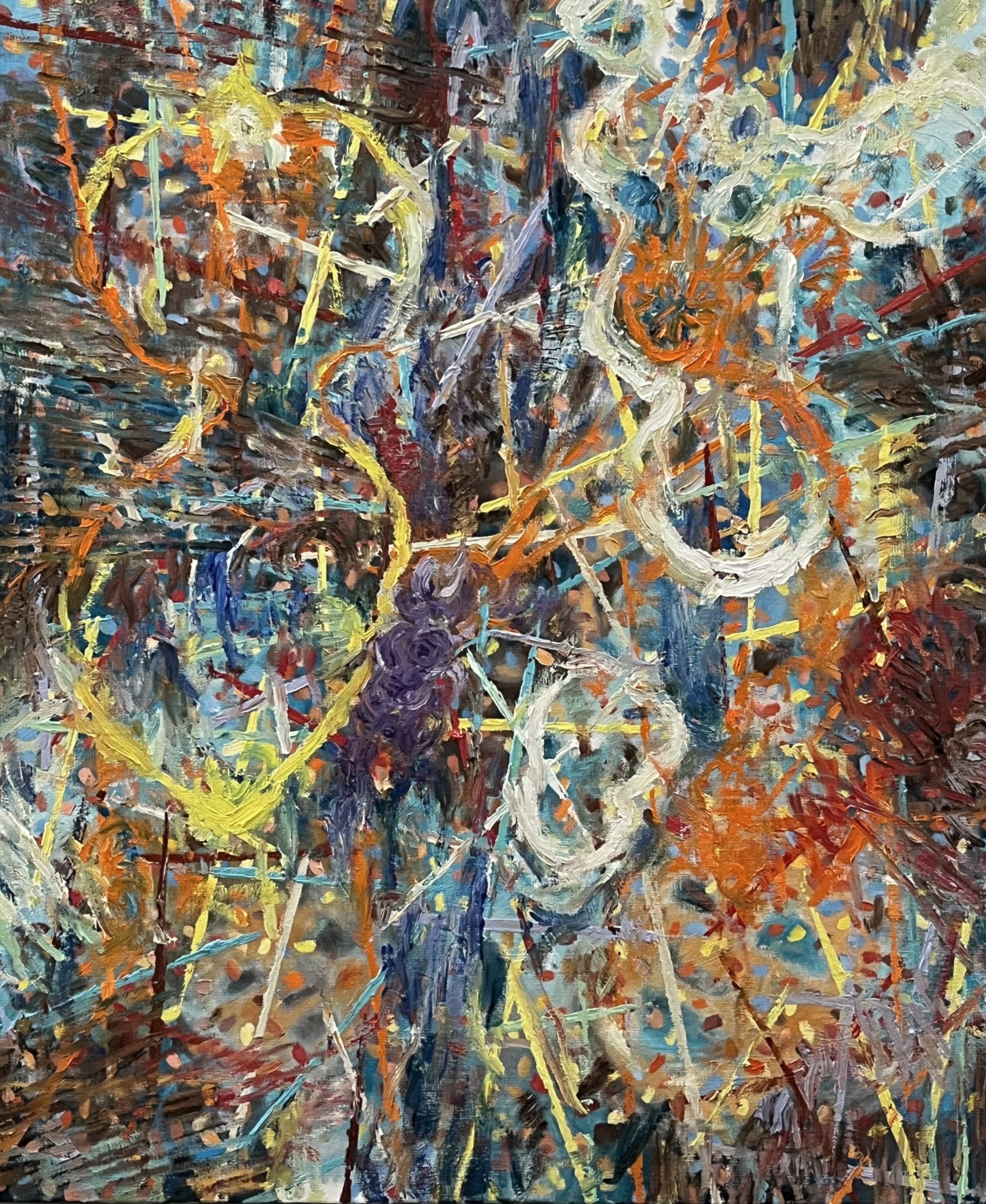
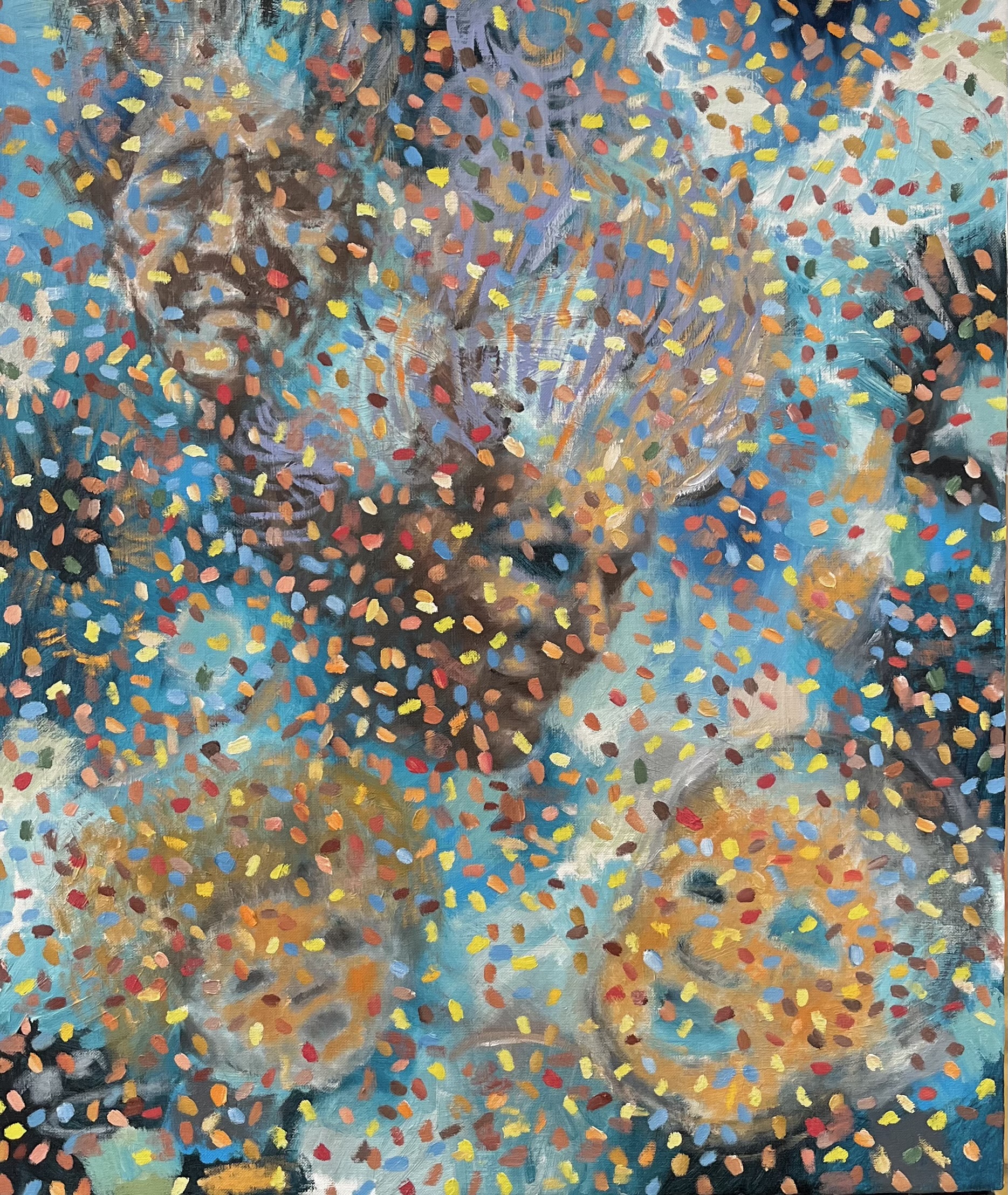
The painting on the left was created by overpainting the half-finished oil painting on the right.
What does it mean to construct form through color?
Typically, when making a painting, one begins with a drawing or outlines to define the contours, fixing the form first before laying color over it. However, form inherently tends to behave in a patriarchal manner—a tendency vividly manifested in much of the work categorized as “realism.” I reject this patriarchal nature; what I truly desire is to create form through color.
Yet, attempting this risks causing the paint to devolve into something akin to playing in the mud, spiraling into unmanageable chaos… and here lies the crucial point: I believe that unless one embraces this very chaos of the material, depicting form through color becomes impossible.
The painter who successfully constructed form through color was Henri Matisse. One need only recall his paper cut-outs to see this clearly. In that sense, Matisse represented a monumental innovation, and virtually every artist following him has been influenced by his legacy to some degree.
How, then, can we construct form through color in the present day?
In my practice, the answer lies in transforming the surface of the canvas itself into a palette. Rather than arranging paint on a conventional palette, I place the paint directly onto the painting’s plane. As a first stage, I lay down dots and allow them to dry. Next, I apply paint in lines, connecting and blending colors while they are still partially wet (tacky) to forge forms of color. Consequently, form is never pre-visualized or predetermined—it emerges organically from the juxtaposed colors and the underlying drawing.