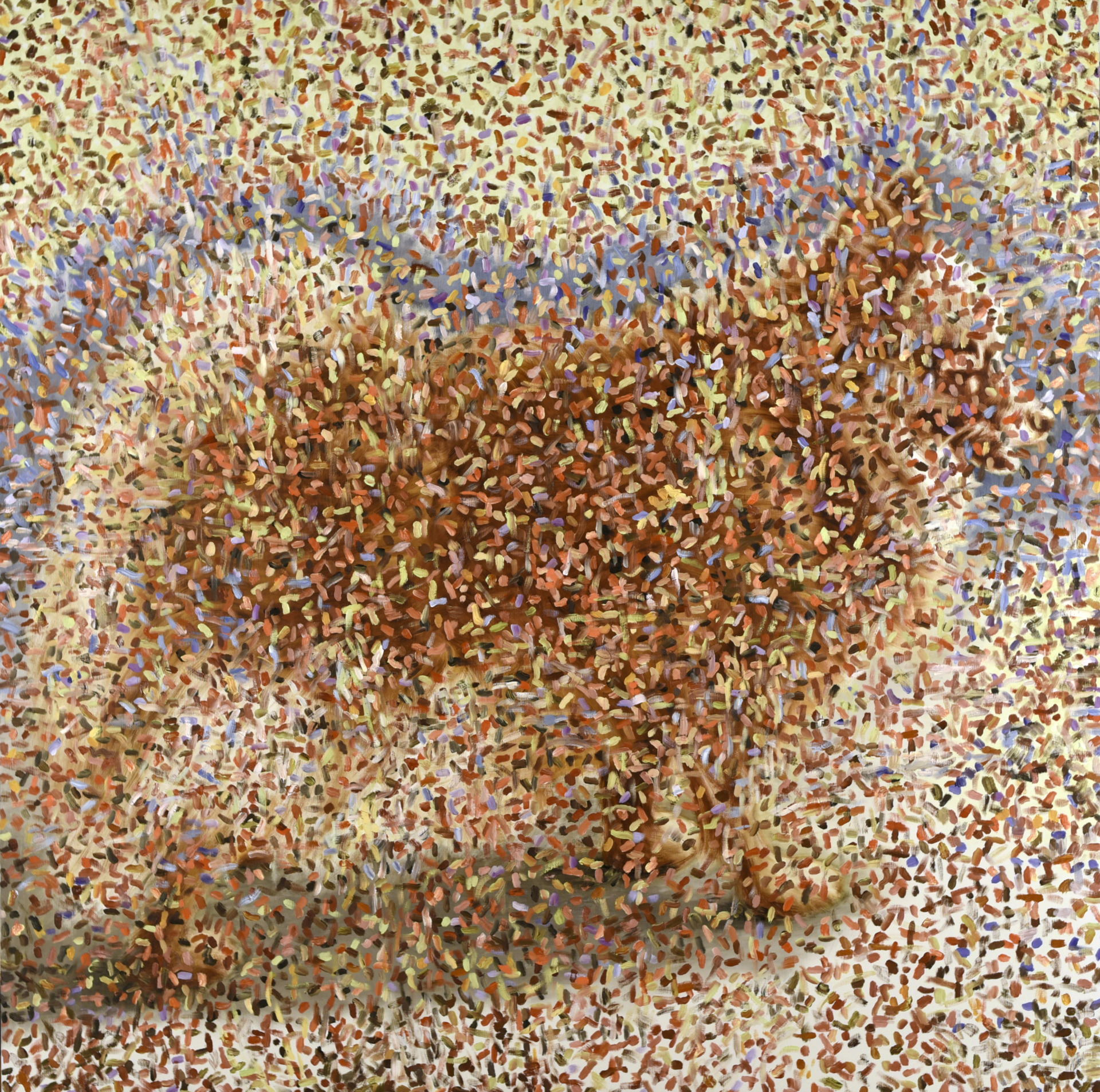
<Pomeranian, 1969> oil on canvas, 194x194cm, 2016
…(Omission)… The broad encounter with quantum theory—the idea that humans are also particulate beings—is profound in its own right, though it bears no direct relation to our lives on a macro scale. The quantum realm is one of the microscopic. Nevertheless, the hypothesis that particles do not exist as specific, fixed states in that micro-world remains a staggering realization.
What fascinates me most in quantum theory is the concept of Superposition. This is a state in which “A” and “B” exist simultaneously, and it is here that interference occurs. While we can observe the interference patterns resulting from superposition, the state of superposition itself remains invisible. This state of harmony is called Coherence, and its collapse is known as Decoherence. It is said that decoherence occurs the moment a quantum entity comes into contact with macro-level matter. These hypotheses and concepts lead us toward the very origins of the universe and the composition of matter; they extend further into our imagination of how life emerges from matter, and how consciousness comes to dwell within it. Metaphorically speaking, it is akin to how a sequence of words gives rise to staggering depths of meaning and emotion. Moving further, it relates to how the material substance of paint transforms into something else entirely upon a two-dimensional plane.
To be more specific: the state of the brain before a stroke is made exists in what quantum theory calls “superposition.” When that thought is realized—that is, when the material of paint is applied to the canvas—a state similar to “decoherence” occurs. I say “similar” because, while pure decoherence is a convenient state for the pragmatic calculations of a quantum computer, an actual painting retains its state of superposition even as it exists in the moment of contact with the macro-world. The “meaning” and “image” emanated from the work mix with the viewer’s consciousness, returning once again to a state of “superposition.” It is through the viewer that the work truly becomes a painting. Naturally, I am speaking metaphorically; I am not attempting to explain painting through the strict laws of quantum physics. However, I find myself deeply drawn to this logic.
Even when analyzing the background of my creation in this way, I do not think of such complexities while in the act of painting. Certainly, there is a grand concept and a clear procedure, yet I cannot—and do not intend to—visualize a finished image. The act of making a painting is something more physical and raw. By “physical,” I mean the way in which the body confronts matter. Much like an athlete in motion, one does not overthink. Yet, while creating, there are thoughts that flicker through the mind at immense speed—things that remain unknowable. Carving those fleeting thoughts into the physique, the painting is formed through the body’s performance before the canvas. Even so, the painter does not immediately know what it is they are truly drawing.