GALLERY MoMo 两国将于2026年2月21日(周六)至2026年3月28日(周六)举办长泽秀之的个展“重绘”。
Nagasawa – “Over painting”
The exhibition “Over painting” is an inquiry into how the act of painting relates to time, and how the act of “seeing” can function as both a physical and ethical practice. Throughout his career, Nagasawa has consistently reframed vision not as a subjective faculty, but as an “event” in which the world itself coalesces into an image. This exhibition serves as a site where his thought and practice are reorganized through the method of “over-painting.”
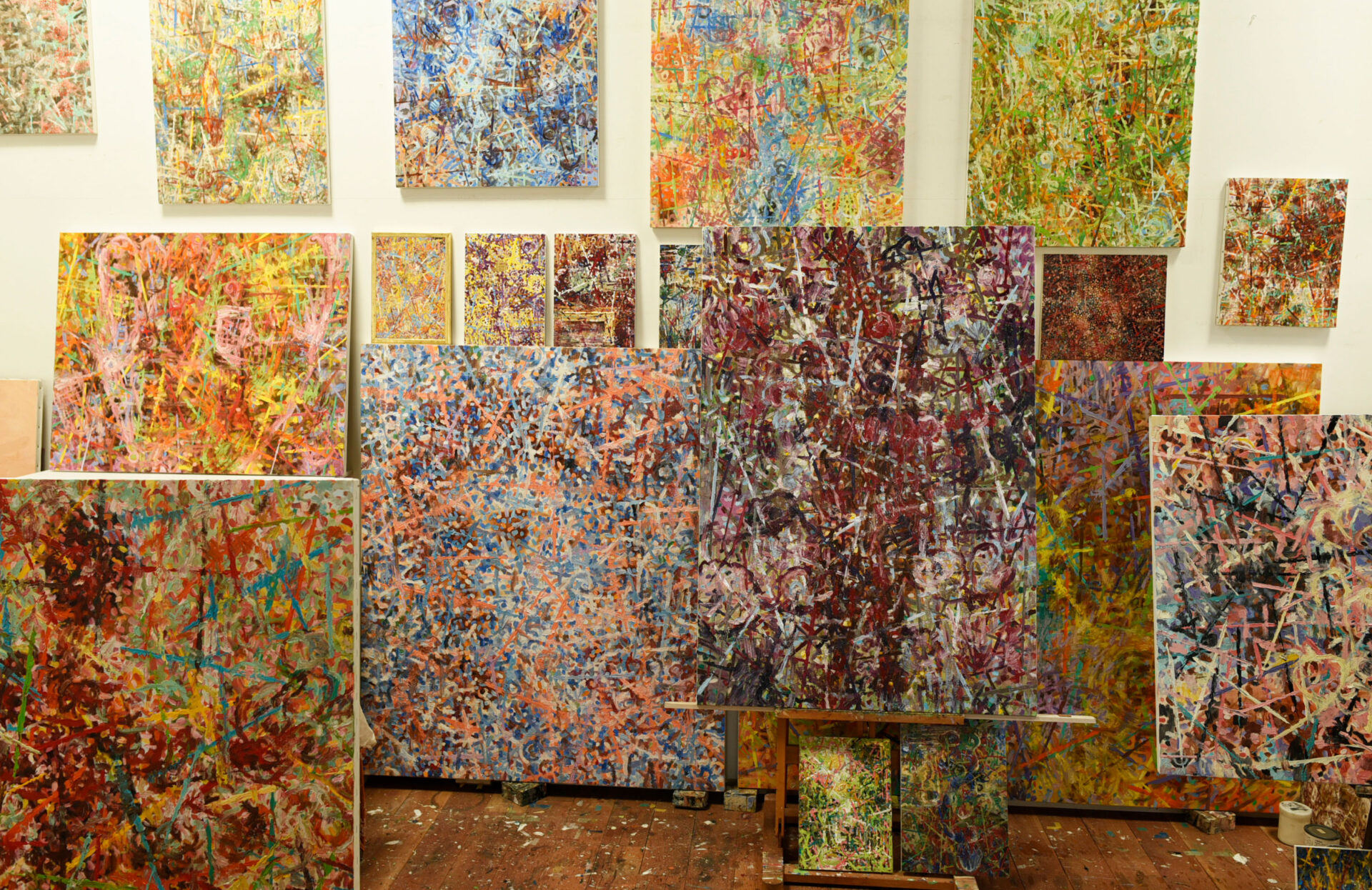
The point of departure for the exhibition is a single portrait photograph dated 1938. Referencing this photograph, Nagasawa employs pointillist applications of paint to simultaneously manifest and obscure the image. Here, painting and erasing are not opposing forces but simultaneous occurrences. While the image is deconstructed, it is never fully erased, persisting in the depths of the canvas. This “remnant” (zanzon) does not manifest as a semiotic sign to be read, but as a material trace of time and memory.
Following a period of profound interruption brought about by the pandemic, Nagasawa experienced a crisis where the act of creation itself became untenable. This fundamental skepticism toward painting as a medium shook the very premises of his practice. In 2024, Nagasawa made the choice to revisit unreleased past works and subject them to “over-painting.” This is not an act of revision or restoration, but an operation to force a collision between disparate times and bodily sensations onto a single surface. Over-painting does not retrieve time; it amplifies it.
The exhibition presents a body of work where studies and previously exhibited pieces created since 2017 serve as the “base layers” (kiso) upon which new layers of painting are superimposed. Through a repetitive process of painting, erasing, covering, and repainting, the works emerge not as finalized images but as sites where time accumulates. The surface of the canvas is not a fixation of a single moment, but a “cross-section” through which multiple temporalities act simultaneously.
The central theme permeating Nagasawa’s oeuvre is “seeing.” His 2006 exhibition Megamiru proposed the perspective that “It is not ‘I’ who sees, but the ‘eye’ that sees,” an attempt to decouple vision from the subject’s possession and re-situate it as a function of the world itself. This sensation—which Nagasawa terms the “Cosmic Retina”—approaches painting not as a result of representation, but as a trace where “that which is being seen” has accidentally settled. These works exist as two-dimensional objects on a wall, yet they are also the vestiges of the occurrence of vision.
The exhibition also includes works themed around the 1944 Tsushima Maru* sinking incident. For Nagasawa, painting is not an autonomous realm severed from reality. Confronted with the ongoing realities of war and violence, painting may expose its own helplessness; yet, what remains for the artist is to “see” the events that have occurred within his own history and to continue the act of remembrance. The Tsushima Maru incident is integrated into the temporal structure of this exhibition not as a past event, but as a catalyst for contemporary ethical inquiry.
Formally, the works are characterized by the deconstruction of the image through dots and the foregrounding of the paint’s materiality. The operation of covering existing images with dots reduces them to a “zero-dimension,” while the intervention of one-dimensional lines drawn with the handle of the brush and the raw, tactile presence of the paint itself open the canvas. Rather than an ordered construction, the works unfold as a process of “becoming” where body and time intersect.
“Over painting” is an attempt to redefine painting not as a matter of completion or representation, but as a site of continuous collision between time, memory, and the body. Past, present, and future are not arranged linearly; instead, they overlap and interfere with one another, emerging as a “memory yet to be seen.” The viewer is invited to be physically enveloped in this site of emergence.
* On August 22, 1944, toward the end of the Pacific War, the Nippon Yusen cargo ship Tsushima Maru, evacuating schoolchildren from Okinawa to Kyushu, was sunk by torpedo attack from a U.S. submarine off the coast of Akuseki Island in the Tokara Islands. The incident claimed the lives of 1,484 people, including 784 schoolchildren.