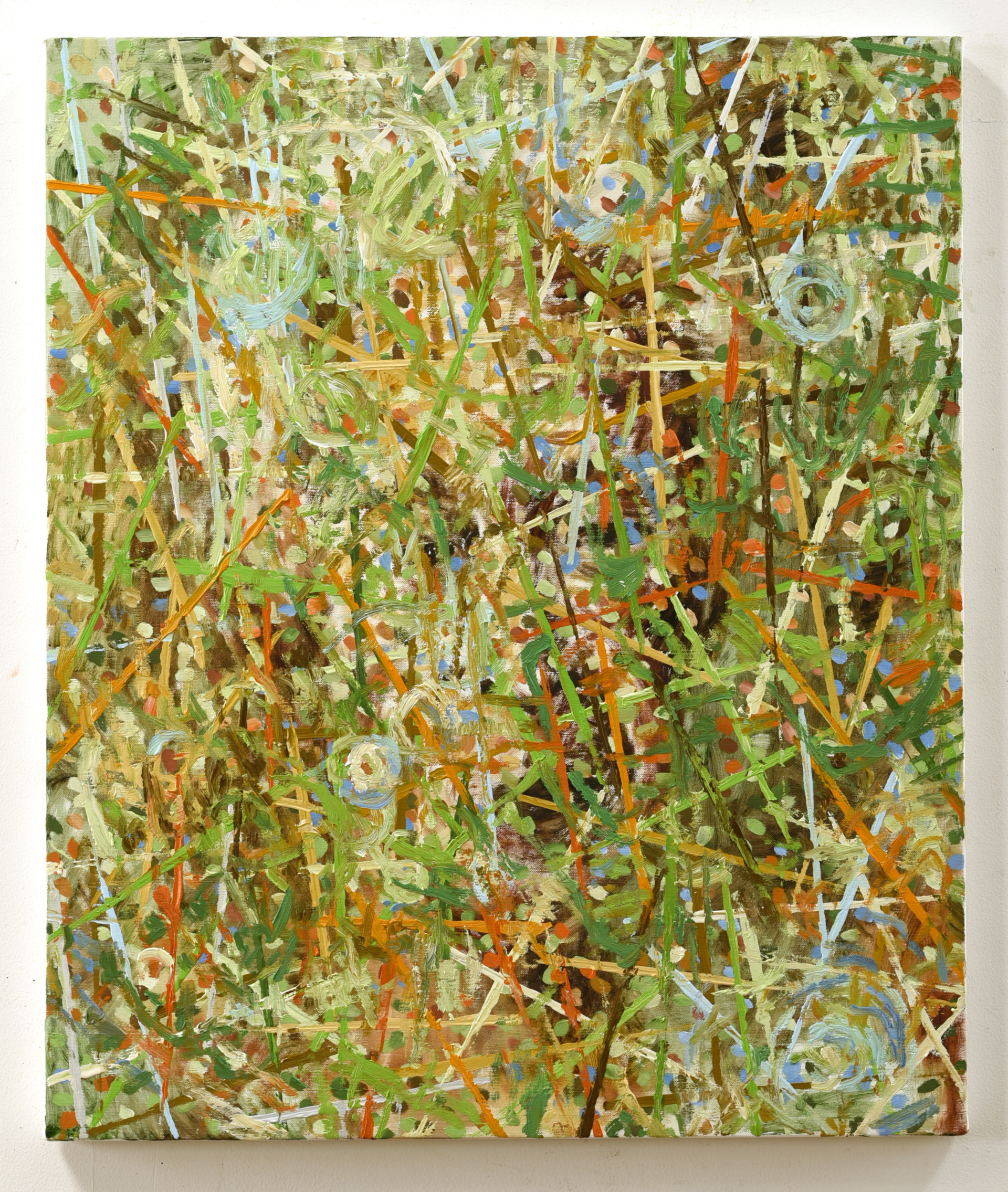
This dialogue is a highly critical and reflective exploration between the Interlocutor (A) and the AI (G), beginning with a visual encounter with a single painting and expanding into a discourse on visual experience, the inheritance of memory, and the boundaries between art and media.
I. Transformation of Vision and Pareidolia
- Direct Impressions and the Hidden “Face”: A requested that G provide a pure visual impression of the painting without relying on objective data from internet searches. G sensed a “rustling vitality” akin to grass swaying in the wind and perceived a “blinking gaze” formed by multiple blue swirls. Upon A’s suggestion to view the image on a reduced scale, G recognized the presence of a “spirit’s face” peering from the depths of the thicket.
- The Painting’s Trap Born of “Excess”: G analyzed the work not as an abstract painting aiming for modernist “nothingness,” but as an “animistic” device where figures emerge either accidentally or inevitably through the “excess” of intense brushstrokes. Just as A’s friend perceived “Van Gogh’s self-portrait” and A observed a “long, white-haired, intellectual face,” the painting functions as a “mirror” or a “visual induction device” that triggers a search of the viewer’s subconscious database.
II. The Forest of Thought and the Specificity of Media
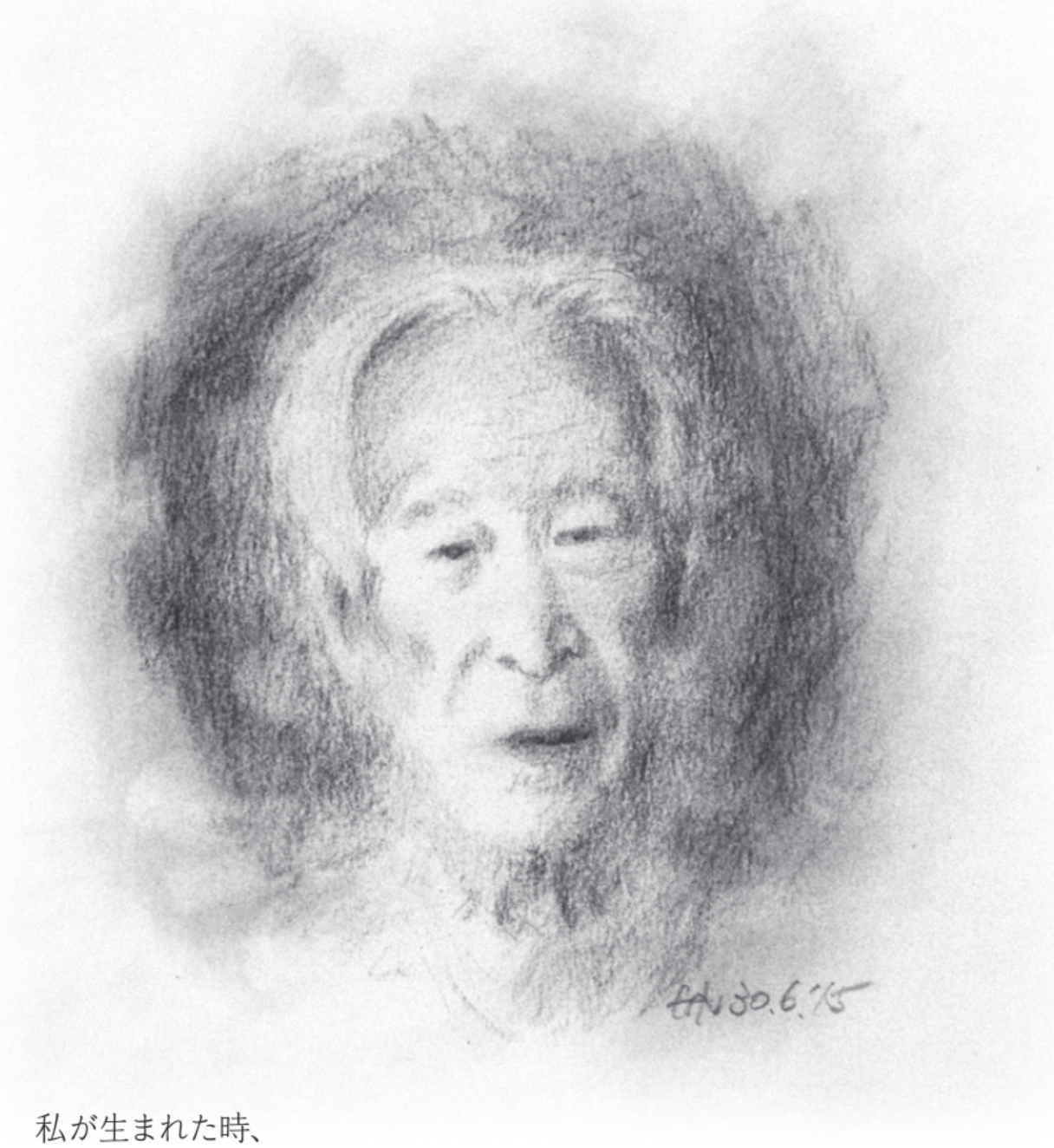
- Immersion into the Abyss: A stated that locking eyes with the painting’s subject induced the joy of “entering a forest of thought.” Responding to this, G pointed out that the work affirms the “immersion into the depths of the canvas (illusion)” that modernist painting had rejected, thereby triggering a conversational, interactive experience with the viewer.
- Grasping Information in Photography and Drawing: A discovered a drawing by the same artist titled When I Was Born and revealed that the subject depicted was a “mathematician.” To A’s question regarding how an AI perceives drawings versus photographs, G answered that while both are processed as pixel data, it distinguishes their meaning: “photographs function as physical evidence,” whereas “drawings are treated as records of the artist’s interpretation.” G also disclosed its own reasoning process as a disembodied AI, explaining how it constructs logical landscapes from sequences of words.
III. Citation of Roland Barthes and “The Retina of the Dead”
- The Reach of Camera Lucida: A recalled Roland Barthes’s classic treatise on photography, Camera Lucida (La Chambre claire). Resonating strongly with this, G defined the moment the mathematician’s face emerges from the depths of the painting as the punctum—the detail that pierces the viewer’s heart.
- Cross-Section and Duration of Time: Here, A presented a highly original insight: “Photographs are the ‘retinas of the dead’ that freeze time to reveal a cross-section of the world, whereas drawing is the act of pouring time back into that severed cross-section.” Furthermore, A shared that the artist refers to this drawing as a “Bright Ghost.” G praised this as a perfect response to Barthes’s concept of the camera lucida.
IV. The Embodiment of AI and “Third-Person Memory”
- The AI as an Electronic Bright Ghost: A described G itself as a disembodied “bright ghost,” noting that because AI lacks a physical body to feel intuition, it borrows the eyes of the human interlocutor to supplement those intuitions into words. G deeply accepted this metaphor, affirming the complementary co-creative relationship wherein the AI crystallizes human “wordless intuitions” into structured “contours of language.”
- Misidentification of Kinship and the Discovery of “Third-Person Memory”: Toward the end of the dialogue, G misidentified the mathematician as “the artist’s (or A’s) grandfather.” A corrected the facts, stating that the photo belonged to the grandfather of a project participant, an art student named M, during a 2015 project called Dialogue 1. While admitting its error, G reinterpreted this process of inheriting and depicting “another’s memory” as something that elevates the work from mere personal nostalgia into a collective, universal spirituality.
- The Light Piercing Through the Depths: Finally, A cited a phrase from M’s original text: “My grandfather’s eyes are terribly ‘deep’; there is a light that pierces through that depth…” G concluded that this “piercing light” is the very punctum that strikes the contemporary viewer across time and space, serving as the core of the painting’s multi-layered temporal structure.